
Miami will avoid the 2023 housing market downturn

According to Goldman Sachs, Miami will avoid the 2023 housing market downturn while ‘overheated’ housing areas like Austin take a beating.
The Fed’s continued battle against inflation caused mortgage rates to jump from 3% to 6% in 2022. This has sparked the second-largest decline in housing prices since the post-WWII era. On the one hand, national home prices fell 26% during the housing meltdown from the 2007 peak to 2012. By comparison, U.S. home prices declined only 2.4% between June and October. On the other hand, there may still be a lot of gas in the tank, because property prices keep declining.
What Goldman Sachs expects for 2023
Take a look at the Goldman Sachs study titled “Getting worse before getting better”. In their report, investment bank researchers made the case that the national housing market correction will last until 2023: “We are downgrading our 2023 projection for the Case-Shiller Home Price Index year-over-year decline from -4.1% to -6.1%. Through the end of this year from June 2022, this would imply an overall peak-to-trough decrease in U.S. home values of almost 10%”
According to Goldman Sachs, a 10% peak-to-trough decrease in national home values shouldn’t cause too much financial harm. Those values rose 41% between March 2020 and June 2022. However, the company says some local markets won’t be as fortunate.
“This reduction should be modest enough to prevent widespread mortgage credit stress, and a rapid rise in nationwide foreclosures seems improbable. The overheated housing markets in the Southwest and Pacific coast, including San Jose, Austin, Phoenix, and San Diego MSA, will probably experience peak-to-trough declines of over 25%, posing a localized risk of higher delinquencies for mortgages originating in 2022 or late 2021,” said Goldman Sachs.
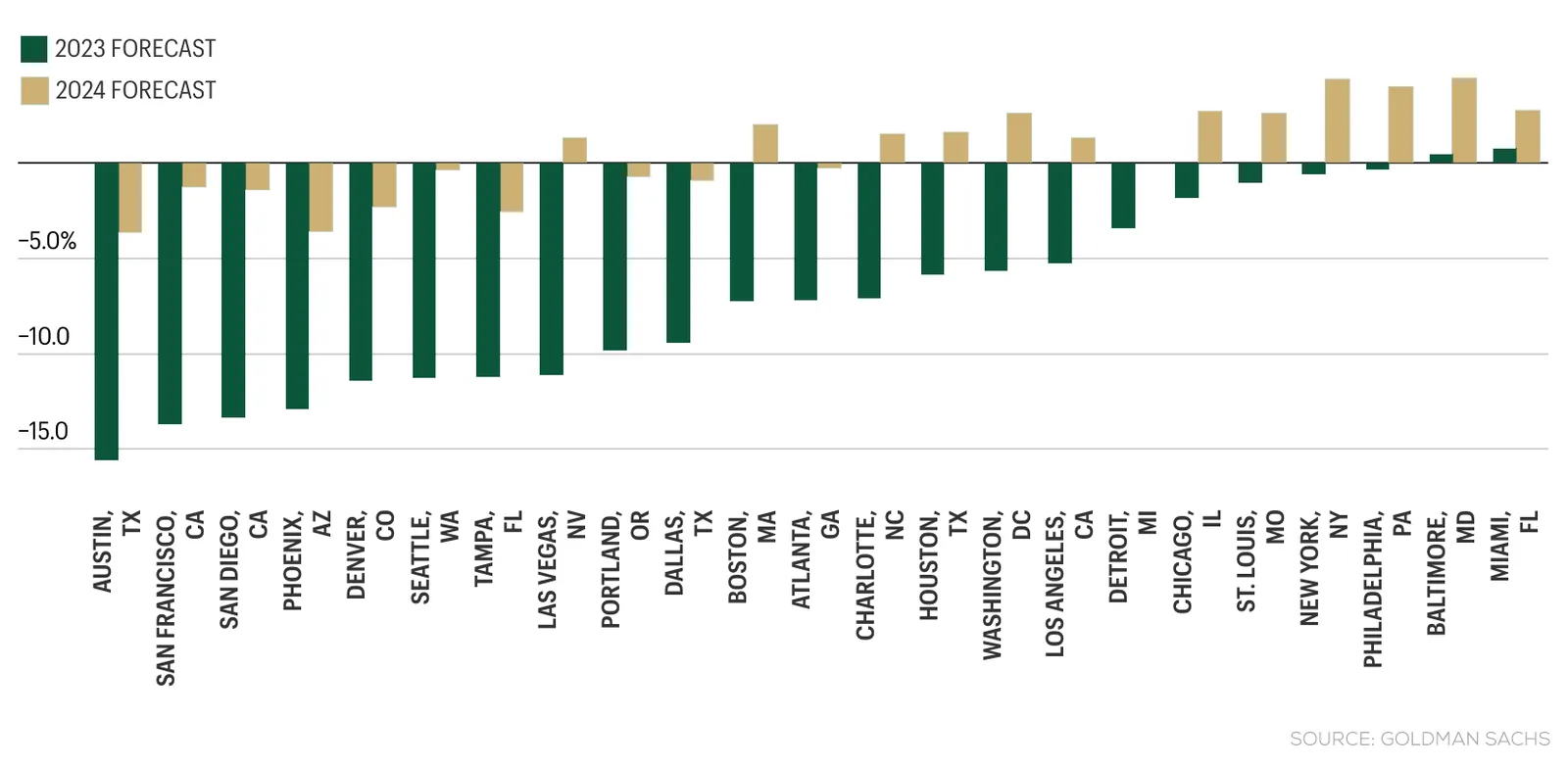
Which markets will suffer most
Goldman Sachs anticipates double-digit home price decreases in 2023 in big locations. These include Austin (-15.6), San Francisco (-13.7%), San Diego (-13.4%), Phoenix (-12.9%), Denver (-11.4%), Seattle (-11.2%), Tampa (-11.2%), and Las Vegas (-11.1%). Additionally, the housing price correction affected those markets the worst in the second half of 2022. In fact, Austin’s housing prices are down 10.4% from their peak in 2022 as of November.
Why does Goldman Sachs believe that markets like San Diego and Austin will take the biggest hit from the correction?
Why “overheated” markets take the biggest hit
The investment bank claims that such markets are “overheated”. This suggests that during the Pandemic Housing Boom, home price increases there became too disconnected from fundamentals. When mortgage rates increase, as they did in 2022, being removed from fundamentals can be especially damaging. Although it anticipates a 6.1% decline in U.S. home values in 2023, the bank does not expect a protracted downturn like the previous bust. Even as regions like Austin and Phoenix continue to experience declines, Goldman Sachs predicts a 1% increase in U.S. home prices in 2024. According to Goldman Sachs, home price growth will probably switch from depreciation to below-trend appreciation in 2024. “Assuming the economy maintains on the path to a soft landing, avoiding a recession, and the 30-year fixed mortgage rate falls down to 6.15% by year’s end 2024,” the firm writes.
Where mortgage rates stand now
The average 30-year fixed mortgage rate, as determined by Mortgage Rate Daily, peaked in November at 7.37%. However, financial restrictions have loosened due to recent pleasant news regarding inflation. As a result, the average 30-year fixed mortgage rate has decreased to 6.09%.
Sources: Goldman Sachs
More to read

Buying in Manhattan and Beyond: Condo or Co-op? A Guide for New York Buyers
Read article
New York vs Miami Real Estate: What Buyers Should Know in 2026
Read article