
Real Estate Speculation and the Efficient Market Hypothesis

The concept of Price to Rent Ratio leads us to another phenomenon. This phenomenon influences the real estate market and, at the same time, is influenced by it.
Speculation and the real estate market
We are talking about speculation.
Everyone has heard about speculation, mainly in the financial, insurance and currency markets. Many people have also put speculation strategies into practice there, with short, medium and long-term objectives. In real estate the objectives are similar. However, the techniques and assumptions are very different.
As already mentioned, rigidity and non-reactivity are innate characteristics of the real estate market. In fact, adjustments of the supply or demand curves need time to materialize. Nonetheless, even in this market we can observe marked phenomena of speculation, albeit with other characteristics.
The goal of speculators is to obtain profitability from the investment. For example, they may seek rent, a capital gain from resale, or both.
How rigidity fuels speculation
Rigidity on the supply side can foster these goals. In the short term, a large increase in demand will cause prices to rise, because supply cannot react quickly. This can easily trigger expectations of further increases.
In addition, rising prices raise expectations of high returns among builders and market operators. As a result, they start new buildings, which reach the market only after a few years. Meanwhile, investors can also decide to move capital from alternative investments. Real estate becomes the object of their attention, both as a safe haven asset and as an opportunity for speculative maneuvers. Therefore, demand grows.
So the pressure depends on the forecasts and expectations of investors. These can, in turn, influence or determine speculative dynamics. In other words, they can trigger a speculative spiral in which a price increase causes further increases.
The efficient market hypothesis
To better understand speculation, we have to start with the efficient market hypothesis.
In financial economics, the efficient-market hypothesis (EMH) states that asset prices reflect all available information. In other words, according to this theory, a market is efficient when all investors have the same knowledge. Therefore, the prices of listed products perfectly reflect the available information.
In an efficient market, there is no asymmetric information. Therefore, the price of a product is a fair and “real” value, which we call “fundamental value” (FV).
However, the real market is characterized by asymmetric information, external factors and psychological beliefs. For example: “If I don’t buy now I won’t buy anymore, house prices are always rising, these are safe investments”.
So we can say that the price is always the sum of the FV and an additional variable value (ΔP). This value can be positive or negative, and buying or selling behavior determines its amplitude.
The starting data therefore tells us that
P (Price) = FV (Fundamental Value) + ΔP (Variable Value).
Estimating the fundamental value
To understand if we are in a highly speculative phase, we must understand how wide the ΔP value is. To do this, the best method is to determine the FV and measure the difference with current prices.
To estimate the FV, a reliable criterion is the historical price trend. We assume that, in the absence of speculation, prices vary continuously. At first, real estate revalues in line with the rate of inflation. If salaries increase more rapidly than inflation, we can assume that real estate prices reflect this growth rate. If growth is also accompanied by low interest rates, the increase in real estate prices will be greater than the increase in incomes. In fact, interest rates are among the exogenous variables that influence the market (we will see this later).
A basic example
This method of estimation is rather basic. It does not take external variables into account, but it can help in evaluating the FV.
To give a concrete and very basic example, let’s assume that in the last ten years there has been an average price increase of approximately 3% per year. A specific property was purchased 5 years ago for 200,000. By applying an annual increase of 3%, this property should today have a value of approximately 225,000. However, if we find it on the market at the price of 280,000, we can assume that the ΔP is high. Therefore, the property is probably the object of a speculative maneuver.
If we apply the same concept in general and consider market averages, we can get an idea of the level of speculation. In this way, we can understand if we are in a bubble phase.
Measuring speculation
In a phase of intense speculation, the ΔP value can be very large. As a result, it distorts the true price, or value, of an asset. By definition, the speculative phase is also temporary and unreliable. Therefore, it is important to understand if the prices of a given period are distorted by speculative variables. For this analysis, the market offers some solutions.
One of these is the Price to Rent Ratio, already analyzed in the previous chapter.
We have already seen that dividing the average purchase price by the average annual rent gives a coefficient. This coefficient mathematically evaluates the ratio between the price and the rent of a property. In general, if this coefficient is very high, purchase prices are in a phase of overvaluation. In that case, it is much more convenient to rent than to buy. On the other hand, when the coefficient is low, the value of real estate is underestimated.
A concrete example
Let’s take a concrete example. A comparative market analysis of a one-bedroom apartment in a given neighborhood suggests a market value of $420,000. Then we analyze the rental market. We find that this type of apartment rents in the neighborhood for an average of $4,300 per month.
In this case, the Price-to-Rent Ratio is 420,000 / 51,600 = 8.14. For this property, it is much more rational and convenient to buy than to rent. In addition, it even yields a gross cap rate of about 12% per year.
This figure, extended to the average of a certain period and zone, suggests that the price of 420,000 is underestimated. On the one hand, we can expect a probable decrease in rents. On the other hand, we can expect a probable increase in the purchase price. In any case, from the point of view of the purchase price, we can affirm that we are not in a speculative bubble phase.
Studies on speculation
Every year, studies and reports try to predict the trend of the real estate market through the study of speculative phenomena. For example, an interesting study by UBS assigns a risk index to the main cities in the world where speculative phenomena occur 1.
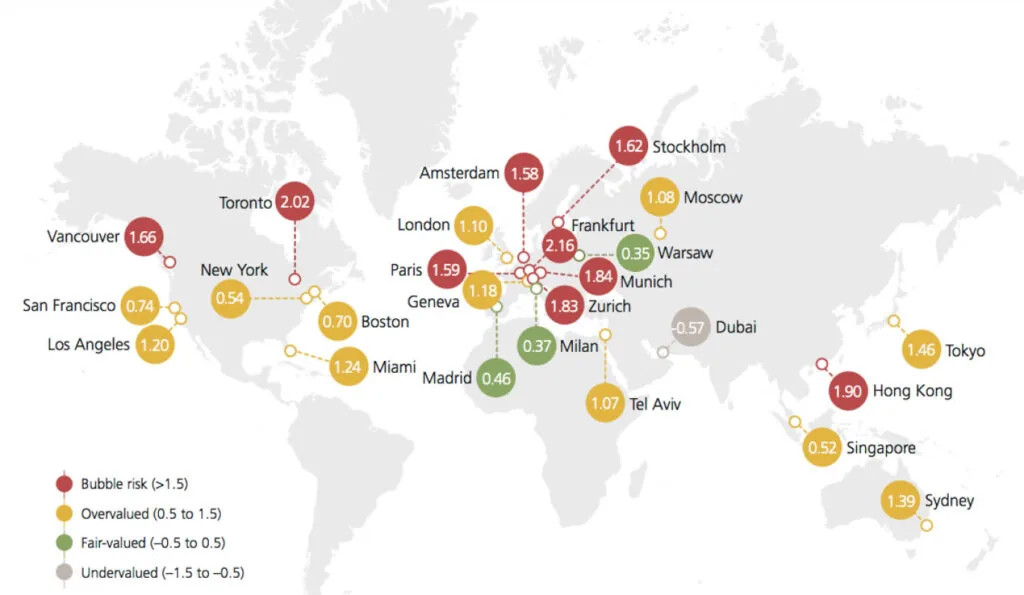
Of course, there are many other factors to consider when it comes to speculation. Moreover, most often they depend on local markets.
1 Source: UBS Global Real Estate Bubble Index 2021, www.ubs.com/global/en/wealth-management/insights/2021/global-real-estate-bubble-index
More to read

Moving From New York to Miami in 2026: Taxes, Domicile and What to Do With Your NYC Home
Read article
Buying a Condo in Miami: SIRS and Milestone Checklist
Read article